Since 2016:
60 electrical boxes in public space of Berlin
designed by people living in refugee camps
240 participants from Siria, Iran, Iraq, Afghanistan and Ukraine
collaboration with 8 refugee camps in Berlin
30 teachers, translators, artists and helpers involved
-
A cooperation between
Stromnetz GmbH,
LOVELITE e.V. ,
the refugee camps Rathaus Wilmersdorf (ASB),
Karlshorst (DRK),
Groß-Berliner Damm (CJD),
Kiefholzstrasse (Schwulenberatung Berlin GmbH). -
With the friendly support of
the Botanical Garden Berlin,
the Nature House‚ Waldschule Plänterwald Berlin.
An Interview with Jenny Brockmann by Martina PachalY
How did you come up with the idea of doing this project with people from refugee camps?
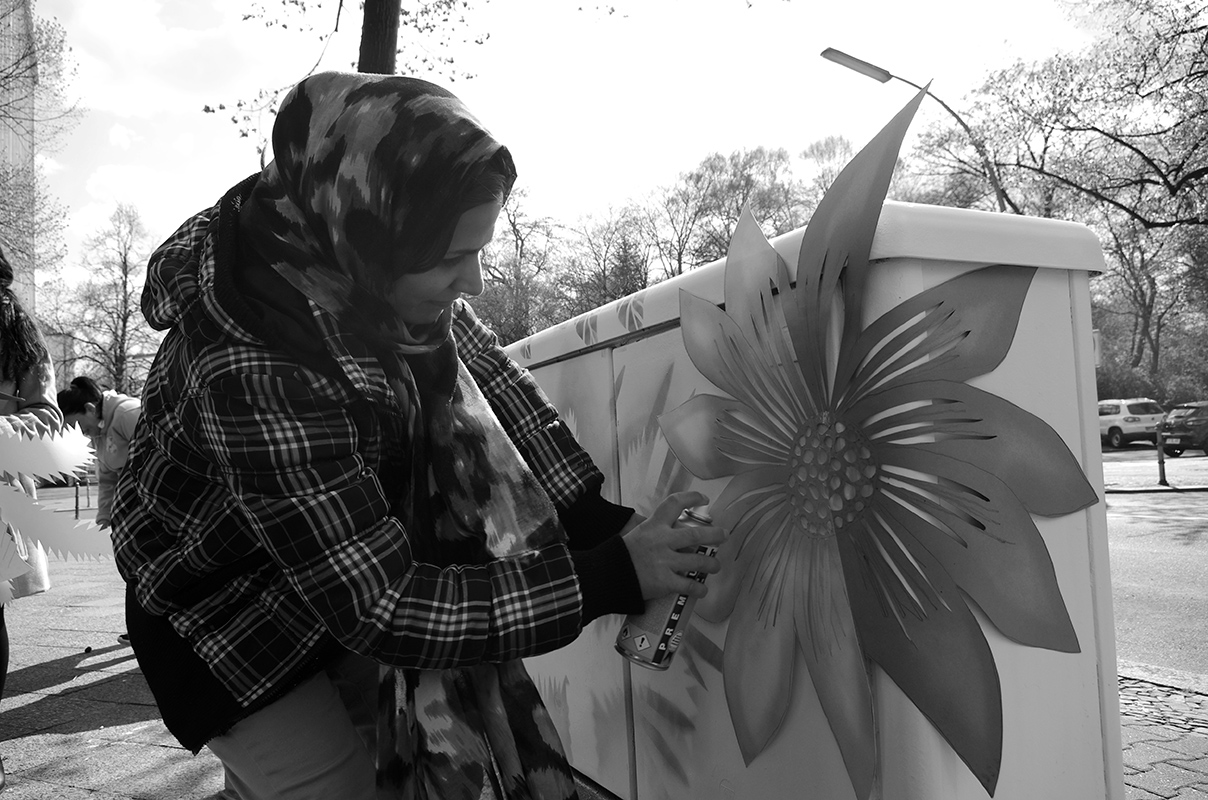
I have been pursuing the art project ‘Chronicle of a Place’ for several years. It is a performance-installation project for which I travelled to Istanbul, New York and Tel Aviv in quest of finding traces of German emigrants in these cities and worked on a description of the location by means of drawings, photography, collages, collection of materials and weather data. When I was invited by Stromnetz GmbH in 2015 to develop a project for cultural education out of my artistic practice, it was natural for me to expand the project ‘Chronicle of a Place’ and to include people who immigrated here. I developed a project of cultural education for people from refugee camps in Berlin. The plan was to go on two excursions during the project week, one to the Botanical Garden, the other one to Plänterwald, a Berlin forest, and after, to draw what was seen and experienced, to develop forms from that, to be made into spray stencils and to be transferred to junction boxes in public space.
How did you come into contact? Did you just go to a camp and ask who would be willing to participate?
Altogether, I was able to offer five project weeks in 2016. During these, I collaborated with four different camps throughout the city of Berlin. Agreement with the camp’s main persons responsible and collaboration with social pedagogues or teachers on site, who already were in touch with the residents and and had knowledge of the infrastructure in the camp, was important here. In some cases, I implemented the project with closed groups, such as study groups. To some extent, other residents, who became aware of the project through already participating cohabitants, were allowed to join.Translators and helpers associated with the camps accompanied the projects. Each camp’s respective direction supported us by having rooms and other things provided for them, thus making our work easier.
What particular experiences did you gather while dealing with people who are refugees?
On the first day of the project, we always went to the Botanical Garden in search for plants from the Middle East. The Botanical Garden, with its beautifully designed and equipped conservatories, enables us to become immersed in another world. To many, drawing showed a new possibility for expression. The excursion to Plänterwald on our second field trip day always had something special. The tranquility that emanates from this piece of nature surprisingly found in the middle of Berlin influenced everybody. In my experience, most people, despite having a shelter here, are still fleeing. They still are terrified of persecution, they worry about relatives and friends they had to leave in the war zone and waiting for the necessary papers to work and live independently in Germany is grueling. Life is unstable and insecure and can uncover bottomless pits under their feet at any time, be it due to news from home or news on site. The project gave the opportunity to escape from this troubled everyday life and become acquainted with the city in the way that people from Berlin experience it every day. I received lots of warmth and thanks as a feedback to this exchange.
November, 2017
Article in the Online Magazine ‘Art in Berlin’ by Inge Pett, 20.04.2016
Cultural Education for People Living in Refugee Camps
“Make it happy today“. Sharmila (all names have been changed by the editors) does not know what a cheerful motto is written on her t-shirt, but when she heard the Farsi translation of the slogan, she was all smiles. Only a couple of months ago, the Iranian woman came to Berlin and since then has been living in the refugee camp in the former city hall of Wilmersdorf. Sharmila is one of the participants of the one-week project ‘Chronicle of a Place – Cultural Education for People Living in Refugee Camps’ (18th – 22nd of April 2016), initiated by Berlin-based artist Jenny Brockmann. Monday started with a field trip to the Botanical Garden in Dahlem, where each of the women chose a plant and copied it by drawing.
This was a great hurdle for 54-year-old Leila from Afghanistan, as in Germany, the mother of nine held a pencil in her hand for the first time in her life. Thea, a retired teacher who voluntarily looks after the literacy course at Fehrbelliner Platz, gives an account of Leila’s initial troubles. Not only couldn’t she read or write, but also she had to get used to the opposite direction of writing in the German language. Currently, the course has reached the letter ‘W’, which Leila oftentimes transforms into an ‘M’ in overeagerness.
The art project also is about abstract thinking, as on Tuesday, the second day, the women drew models of their flowers for stencils, the designs of which they will spray-paint on the sponsor Stromnetz GmbH’s junction boxes located in the neighborhood of the camp on Thursday.
Leila’s shyness regarding the pencil has apparently vanished. With visible pride, she draws the contours of her harmoniously proportioned flower on the cardboard on the wall, onto which Jenny Brockmann projects images.
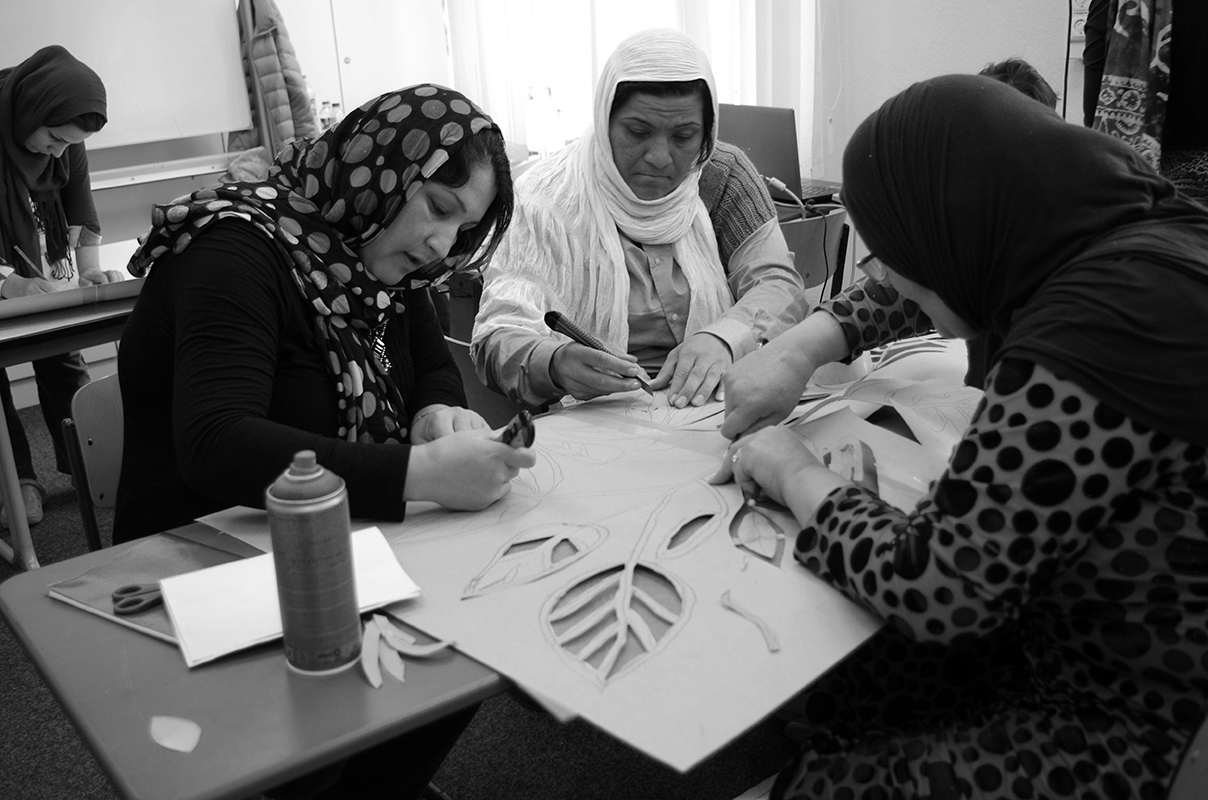
An Iranian woman chose a pink lily, an Afghan women an onion plant. The women agree that their visit to the Botanical Garden was their best experience since fleeing yet.
“They reported on the landscapes of their homelands, their gardens, their crop and decorative plants“, Jenny Brockmann explains. Solely one young woman, who had to witness the murder of her own parents, apathetically gazed into the air. “She hasn’t completely arrived yet“, explains the translator. But however, one senses that it is a good thing for the Afghan to be part of the community.
On Wednesday, the group will take another field trip, this time to the Waldschule in Plänterwald with a picnic following, on Thursday the women will spray-paint the junction boxes; after that, on Friday, the course will end with a walk to the boxes decorated with floral motifs. Overall, Brockmann will put five projects into practice this year, three of which will take place in the refugee camps in Karlshorst. She could not even imagine the type of resonance she would come across: “The women’s enthusiasm about visiting the Botanical Garden alone justifies the whole project“, she rejoices. As an artist, she is predominantly interested in discourse.
Sharmila, who only started wearing her heavy golden cross pendant confidently above her t- shirt a few days ago, is the creative ‘star’ of the group. With dynamic gesture, she drew a feathered palm. She was married as a 16-year-old in Iran and became a mother, she recounts outspokenly. But she took life into her own hands, left her husband and found a new partner who supported her and was proud of her; for example of her starting an art study course for refugees at the Weißensee School of Art. Her career goal: “A designer for Chanel“, she laughs.
She says she has been interested in art, fashion and design ever since she was a young girl, following fashion channels and designing shoes herself back home. Now she turned 40 and her dreams are coming true. Hence, the slogan on her t-shirt is a program: “Make it happy today“.